Monday, May 3, 2010

Si se puede!

I have never actually read the Jungle Book in its' entirety before (seen the movie..), but I really felt like the first chapter discusses a really interesting idea. Was man meant to live in nature (as opposed to separately from it). Mowgli finds himself as a child, adopted by a pack of wolves. Baloo and Bagheera both take him under their wing and teach him the ways of the Jungle. Shere Kahn, however, manages to turn the Jungle against Mowgli, and does everything in his power to kill him. During a meeting with Bagheera towards the end of the chapter, Mowgli expresses his concern: "And what is a man that he should not run with his borthers?...I was born in the jungle. I have obeyed the Law of the Jungle, and there is no wolf of ours from whose paws I have not pulled a thorn. Surely they are my brothers!" (870) Mowgli finds himself in an awkward social situation. He is innocent in every way, yet he still faces persecution because of his background. I feel like you could pretty easily discuss this from a speciest approach, but I want to look (briefly) at whether or not you can expect to live harmoniously with nature. I feel like nature is a beautiful, spiritual, and personal thing for everyone. It is also the most dangerous and risky place for a human to exist. The only environment more dangerous than nature itself is the city. It is almost as if an invisible barrier exists between human culture and natural culture. Over the years, we have become so removed from nature that it has become absolutely foreign to us.


Not only is foreign and dangerous to us, but we are the same for it. As a whole, we always seem to be harming nature in some way. In the Jungle Book, Bagheera confides to Mowgli that he used to be a caged cat. In the white seal, we see another negative effect of humanity on nature: "Yet Seat Catch never chased a beaten sea, for that was against the Rules of the Beach" (878). I feel like most people have a firm grasp on this idea that humans tend to be bad for animals. I grew up in seeing pictures of oil-drenched birds, road-kill, and animals with those can-holders stuck around their necks. It is a sad truth, but half of changing is knowing.


THE END#

Wednesday, April 28, 2010

[Revised[ Lesson Plan for 4-29

Main idea: I want to take a look at the differences between healthy sympathy, and unhealthy sympathy.

If we have time, there are two activities that I would like to do. Firstly, I'd like to read off a few quotes from the DB's that are in so far, and maybe discuss some of the themes that are surfacing (strength's of Poetry as a vehicle for sympathetic imagination, and the validity of some of the views that the poems take themselves.)

After this, I want to do a brief poetry-writing exercise that will allow us to both use creative writing as a means of sympathetic imagination, as well as to experience the degree of difficulty that goes into writing meaningful poetry. Basically, I'll come prepared with a couple scenarios that will serve as the basic premise of the poem (probably two or three). After all the short poems have been written, we'll collect them, mix them up, pass them out, and then read them.

Then, if we still have time, we can discuss individual poems and the effect that they have on us as listeners.

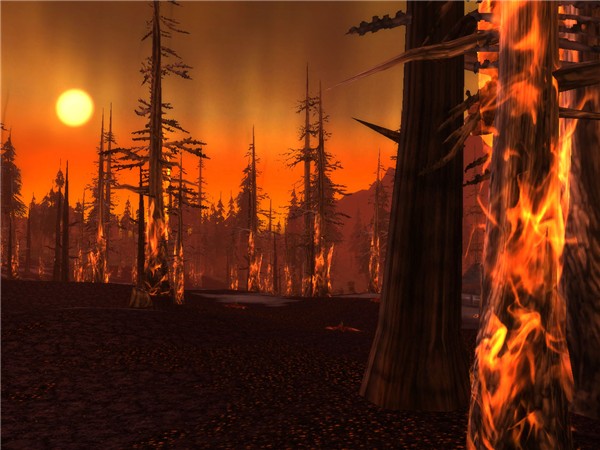
Dangeresque 4: Look out! There is fire on that tree!

Gerard Hopkins' poem "The Windhover" beautifully describes the majestic flight of a falcon as is glides through the air. Hopkins relies strongly on his firm grasp over colorful imagery and description to emotionally guide his audience to sympathize with the scene."Brute beauty and valour and act, oh, air, pride, plume, here buckle! And the fire that breaks from thee then, a billion times told lovelier, more dangerous, O my chevalier!" (841). After reading this, I pretty much wanted to magically transform into a falcon so that I could go fly around and experience this all for myself first-hand. This raises the question, however, of animal cognition. Humans seem to all be obsessed with the nobility of nature. For example, we are awestruck by things like Eagles, Cheetahs, and whales. Something about their behavior strikes us as enchanting and majestic. The question is, however, are animals aware of their own beauty and grace? We know that they are capable of assessing their own skill sets versus the skill sets of other animals, but can they appreciate the aesthetic quality of their grace and appearance? There really isn't any way to tell, but I'm glad that I am able to observe and comprehend how awesome nature is.


On a similar note, something I read from the packet made me question the way I appreciate and understand nature on a daily basis. "Earlier in the century Thoreau had written, 'Sympathy with the fluttering alder and poplar leaves almost takes away my breath... if any part of the forest was burned... I grieved with a grief that lasted longer and was more inconsolable than that of the proprietors" (848). In other words, Thoreau sympathized with ALL nature. He appreciated it, and felt for it. He went so far as to grieve for the burning forest. Being in nature affected the way that he lived out his life. Is this healthy? It is one thing to act in a way that is healthy for both yourself and your environment, but it is something else entirely to be so caught up in nature that it starts to take a toll on yourself as a person. In Thomas Hardy's Jude the Obscure, we see a similar sentiment: "This weakness of character, as it may be called, suggested that he was the sort of man who was born to ache a good deal before the fall of the curtain upon his unnecessary life should signify that all was well with him again" (861). At what point does a sympathetic approach towards nature become dangerous? There are certain things that are easy and healthy to sympathize with, such as stray animals, or farm animals, or anything like that. If I become some consumed with nature that it starts consuming me, however, it gets dangerous. It is important to remember that it is impossible to drift through life as a ghost, without having any affect on our surroundings at all. We must pick and choose our battles. This is my belief, anyways...

Monday, April 26, 2010

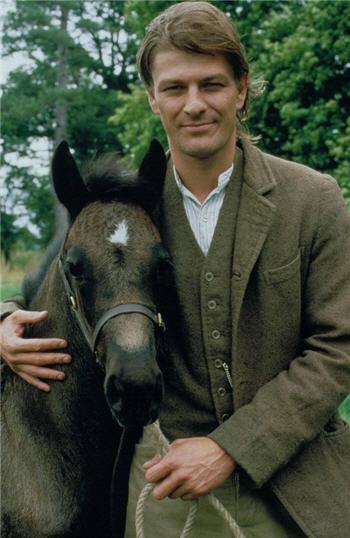
Keanu Reeves and Alex Winters. Oh- and is that Boromir?


Probably my favorite part of Black Beauty comes late in the novel with our favorite hoofed narrator finds himself in the care of Jerry Barker, a london cab driver. Jerry is depicted as a sort of beautifully ethical, simple-minded man. He cares for others just about as much as he does for himself, and he is careful not to get caught up in the trends of the world. Jerry also shows unabashed affection and care (I can't stop saying this word) for Jack (the narrator). The most interesting part of this section of the novel for me came as Jerry and some of the other drivers quickly discuss religion and ethics. ""There is no religion without love, and people may talk as much as they like about their religion, but if it does not teach them to be good and kind to man and beast it is all a sham . . . " (Chapter?). I cannot possibly vocalize how much I agree with this statement. I don't necessarily think that this sentiment should be applied specifically to religions, but rather to just life in general. If Jerry is capable of figuring out that religion should benefit both man and beast, then we as humans should be capable of living our lives in such a way that they benefit other humans and animals.


First of all, there is no religion without love. I absolutely love this. One of my favorite quotes of all-time that sum's up the central message of Christianity was said by Napoleon Bonaparte (the "short, dead dude". Great Movie...). It goes: ""I know men and I tell you that Jesus Christ is no mere man. Between him and every other person in the world there is no possible term of comparison. Alexander, Caesar, Charlemagne, and I founded empires. But on what did we rest the creations of our genius? Upon force. Jesus Christ founded His empire upon love; and at this hour millions of people would die for Him." This is so telling of what the religion was originally founded on, and how far modern-day "Christians" have strayed from this message. I feel like Jerry does an excellent Job of living his life in a way that emanates love, not only to his fellow man, but also to his animals.

The (abrupt)
End.

Wednesday, April 21, 2010

Stereotypes: Steam Engines and (subtly) KFC

Black Beauty by Anna Sewell brings to light another pretty important issue when it comes to animals and our understanding of them. "They always seemed to think that a horse was something like a steam engine, only smaller" (Chapter 29). I am about to take this completely out of context, but I think it is interesting enough of a truth that it doesn't really matter at all. Earlier today at lunch I was talking to a couple of my friends about stereotyping. One of my friends, Abby, said something like "Stereotyping and labeling are necessary to everyday life. I can't not label people." I'm talking mainly about the common racial stereotypes that we are all so familiar with, such as "black people are great at basketball", or "Asians are the best studiers", or "Mexicans are hard workers." These observations are obviously not always true, and many times they are the cause of great offense, but I want to take a quick look at how we apply these same labeling tactics to animals.


When we talk about animals, we always have these subconscious images associated with them. This goes back a little bit to my entry on animals and languages, but I think it goes a little deeper than that. We, as humans, are constantly associating ourselves with things, and then associating those things with other things. For example, I have a good friend who is obsessed with being as sneaky and stealthy as possible. By this point, I have associated her with a cat, because she is always prowling around. Give it two years, and there is a chance that when I hear her name I immediately think "cat!". If you ask me right now what I think of when I think cats, however, I'll probably rattle off a list of their different aspects: mysterious, sleepy, sly, affectionate...all of these things.


In black beauty, we see a horse become associated with a "steam-engine". What characteristics do steam engines display? They are mechanic, durable, strong, and relentless. When a horse in the book becomes labeled as a steam-engine, the driver sub-consciously assigns these attributes to that particular horse. He is made to become a machine. The driver abandons all sense of compassion and sympathetic imagination.


My point in this post is not argue that comparative organization is bad, because I strongly feel like it is a fun and useful linguistic tool (and I think you could argue that it is how we are wired as humans), but I feel like it is absolutely necessary that we remain aware that each individual, whether it be animal or human) is a stand-alone being. A horse is a horse, not a train. My friend is an individual, not a cat.

The end.

Monday, April 19, 2010

Harry Potter, Horses, and the Indian Caste System

Anne Sewell's Black Beauty brings up a couple of interesting issues when it comes to animals and animal behavior in the wild. In chapter one, in the opening pages of the story, the narrator recounts a time when his mother sat him down and explained to him his brief history and his presumed future. "I wish you to pay attention to what I am going to say to you. The colts who live here are cart-horse colts, and of course, they have not learned manners. You have been well-born and well-bred. Your father has a great name in these parts, and your grandfather won the cup two years at the Newmarket races. Your grandmother had the sweetest temper of any horse I ever knew, and I think you have never seen me kick or bite. I think you will grow up gentle and good, and never learn bad ways" (Chapter 1). This concept of bloodline and ancestry when it comes to animals brings to mind the way that we value animals that we ourselves own. When someone buys a show dog or horse, they always want to see its pedigree. Traits are inherited, many times- not learnt. This value (assigned extrinsically) reflects an intrinsic discrimination that we see in all animals. If there are two "laws of life" that we see in animals (namely wild animals) they are undoubtedly to SURVIVE and to PROCREATE. Animals live their lives eating or mating. Many species of animals seem to order their lives around only these two things. If you turn your TV to some sort of animal-related channel, you'll will probably hear or see information about animal behavior regarding these two things. The interesting thing about the procreation part (as far as I'm concerned) is the methods in which many animals choose mating partners. In some species, such as fish, there isn't much order involved at all. In others, however, such as the birds of paradise of New Guinea, partner selection is a process involving plenty of competition, broken hearts, and discrimination. Females, such as the birds of paradise, always chose male partners that they think will give their off spring the most useful genes. In other words, they discriminate against the weak.


I just think this whole practice is slightly ironic, considering many of the things that we have talked about in this class so far this semester. Social discrimination can always, at some point, be watered down to Darwinism in its most basic form. We are animals just like the animals of nature. The narrator's mother in Black Beauty shows a recognition of this class distinction by telling her son that his is "well-bred", noting that he is better off than the cart-horse colts. We read about things like this ALL the time in our Lit-Classics classes. Voltaire's Candide comes to mind, as well every other book that I have ever read, including Harry Potter, The Hobbit, and James Patterson's abysmally written murder mysteries (if you can call them that). My point is this: animals seem to experience the same kind of class distinction that we are so obsessed with as humans.

Another interesting concept that Sewell introduces into her novel is that of India's caste system. If you are interested in the caste system at all but do not know much about it, I strongly urge you to do an hour or two of independent research and NOT to enroll yourself in a Senior Seminar course entitled Indian Literature: Slumdogs and Millionaires. It will drain you. But I digress-in chapter two of Black Beauty, the narrator's mother again gives insightful commentary on the place or, in(dian) our terms...caste, of horses.


The horses have all just witnessed a rabbit chase in which one of the riders has apparently broken his neck. "But though I am an old horse, and have seen and heard a great deal, I never yet could make out why men are so fond of this sport. They often hurt themselves, often spoil good horses, and tear up the fields, and all for a hare, or a fox, or a deer, that they could get more easily some other way. However, we are only horses and don't know" (Chapter 2). The place of the horse, according to the horse (or Sewell?) is a servant. The narrator's mother recognizes that the horses are subordinate to the humans. Obviously, there is no way to understand what is actually going on in a horses mind, but this is a pretty common concept when it comes to portraying animals in books (especially talking animals). We like to tell ourselves that horses want to be our servants, or that pigeons want to deliver messages for us (if pigeon carriers were popular, I might be guilty of animal exploitation...). This is just another random example of animal exploitation! Woohoo! Go team!

The (abrupt) end!

Monday, April 12, 2010

Religion: Jesus, Gandhi, and Pelicans

First of all, these things just seem to get longer and longer (and inevitably more and more incoherent. And full of typos....) Sorry!

When people think of religion nowadays, they almost inevitably think of the ridiculous televangelists telling people that if they don’t donate their life-savings, they are going to die a painful death and live for eternity in hell, or of the tragically extremist approach to religion (like 9/11, or the Crusades). I feel like these understandings, while justified because of the complete abuse and exploitation of religion that goes on daily in world culture, are sadly inaccurate.

According to whoever wrote this specific passage in our course packet, “The one message of all saints and prophets of all times and climes, is the message of love, of Ahimsa, of selfless service” (815). I feel like this isn’t entirely true of all religions, but definitely of most. It definitely rings true with the central message and practice of Christianity. Aristotle (maybe it was Plato, I really can’t remember) taught that the purpose of man was to flourish, and that can only happen in a world of peace, love, and truth. You can’t flourish if kill your neighbor in order to steal his life-savings, and you definitely can’t flourish if your neighbor kills you to do the same. Instead, flourishing, in the original Greek sense, requires a sort of self-sacrifice very similar to the one that we see and hear about in Christianity. Mother Theresa is a great example of what it means to live selflessly for the well being of others. This is what my understanding of ahimsa is.


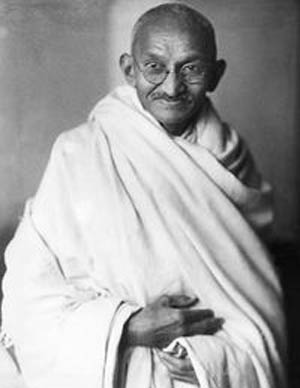
“Nonviolence, according to Gandhi, is the law of the human race and is infinitely greater than and superior to brute force…Nevertheless, ahimsa is the means; truth is the end. Means to be means must always be within our reach, and so ahimsa is our supreme duty. In its positive form, ahimsa means the largest love, greatest charity. According to Gandhi, ‘If I am a follower of ahimsa, I must love my enemy’” (821). So, if ahimsa is a means to truth and understanding (and possibly flourishing), then how can we apply that to all aspects of our lives? Gandhi says that one practical practice (socially) is to love your enemy. Gandhi was known globally for his philosophy of nonviolence when it comes to politics and social issues. Let’s take a quick look at what it means to not practice ahimsa.


If we all lived hedonistic self-serving lives, there can be no doubt that the world would be a little more chaotic than it is now. To be self-serving is to exploit the environment around you (socially, politically, and ecologically…among other things) for your own self-gain. It is reminiscent of sadism: you do what you what, when you want without any consideration for others. When it comes to food, we rarely think twice. I was brought up seeing (in school, movies, books…) Darwinism. Only the strong survive. To eat is to kill, but it is a means of living. Eating is as ironic a practice as I can think of. When you eat something (either a plant, animal, or fruit), you let it grow (while it eats…), until eventually you eat it, destroying all of the growth from the previous days, months, and sometimes years. It is a necessary process.


The idea of ahimsa would argue that while we can’t completely ignore our need to eat, we need to learn how to minimize the destruction involved in eating. “As scientist Brian Swimme has suggested, we are currently making macrophase changes to the life systems of the planet with microphase wisdom. Clearly, we need to expand and deepen the wisdom base for human intervention with nature and other humans”(811). On a daily basis, we make decisions on a “microphase level” that have drastic world-changing effects. The movie “The Butterfly Effect” effectively discusses this concept. I was watching Life last week when a segment about pelicans came on. Apparently, the mass-fishing that goes on in the oceans nowadays in order to supply fish to countries around the world has greatly reduced the population of whatever fish it is that White pelicans like to eat. Instead of moving to where there are more fish, however, the pelicans have simply changed their diet. Instead, now they have begun raiding the nests of some other ocean-dwelling bird (I can’t remember which now), and stealing/eating their young. It was shocking to me. This is just an example of how our lack of ahimsa is having a very tangible effect on our planet.

Monday, April 5, 2010

A Series of Unrelated Thoughts

Glancing back at couple of my peers blog entries from the past (as well as a few of my own), has led me to believe that one of the chief dangers of studying the constant struggle for justice and 'humanity' in the relationship between humans and animals is that it becomes dangerously easy to lose respect for the human race. In times of war, it is pretty standard practice for by-standers to take sides entirely. You are either a yankee or confederate, Nazi or Allie. These readings that we do, while full of rich information that can promote good discussion and even action, are capable or rending the reader for his cornerstone of identity: WE ARE HUMAN! To write us all off as slanderers, viruses, or general disturbers of nature promotes a grossly inaccurate definition of what it means to be a human. I would argue that humans are all born with a potential for both good and evil. We are every bit as capable of growing and flourishing as we are of destructing.
/Rant. I'm not sure if this is going to tie in with my actualy DB entry at all, but I felt like had to say something.

Ok, here we go. John Berger's speculative work, "Why Look At Animals?" defines what a human is by the following: "What distinguished man from animals was the human capacity for symbolic thought, the capacity which was inseparable from the development of language in which words were not mere signals, but signifiers of something other than themselves. Yet the first symbols were animals. what distinguished men from animals was born of their relationship with them." (797). As a linguistics minor, I have always been fascinated with language and speech production. Let's imagine for a second that you are a base, observant being, capable of nothing of nothing but seeing, hearing, and smelling. Now, suddenly, you gain the ability to touch. What do you do? You walk around and touch the things that you had previously observed. You become aware of the feel of the ground beneath your feet, you feel the wind on your neck, you feel the warmth of the sun. Then, you notice that there are others just like you around. You can't interact with them yet, but you see/hear/smell/and feel them there. Finally, you are granted the ability to produce and comprehend language. What do you do? You interact with those around you. You begin to converse with the beings that you had previously noted. How do you do this? By relating a cohesive thought to someone else in terms of the environment around you. This is what Berger is talking about when he talks about how our first symbols were animals. We share this planet with animals, so in order to communicate effectively at all, we almost have to use animals as a linguistic tool. We are comparative beings, by nature, meaning linguistic originality really isn't our thing.


Also, on a slightly unrelated note, I find it pretty interesting that we are just now becoming enthralled with observing nature closely. We discussed earlier whether or not we thought that Fiction or Non-fiction was best suited to help 'mend peoples views' of animals. I almost feel like the best way to educate people about the true nature of animals (meaning their capacities for feeling, lower-forms of speech, ingenuity, and survival) is by studying them in their natural habitat. "People whose livelihood depended on animals naturally noted the economically valuable traits of their stock, but otherwise animals were rarely closely observed." (801). The invention of things like the television, and high definition cameras and photography have revolutionized the way we understand animals. It should be no mystery as to why people rarely observed and studied animals previously: it required them to go SO far out of their way to do so. Now, however, with the help of the TV, and shows like Planet Earth and Life (barring Oprah's terrible narrating), we can almost instantaneously step into the natural world without leaving the comforts of our own home. Suddenly, we are able to look at the natural behaviors and struggles of animals in their own habitats. It not only lists facts to me, but it SHOWS me things as well.


And finally, I wanted to take a quick look at the verse out of Genesis that shows up on page 809 of our course packet.
"And the fear of you and the dread of you shall be upon every beast of the earth, and upon every fowl of the air, upon all that moveth upon the earth, and upon all the fishes of the sea; into your hand are they delivered." -Genesis 9:2
A couple people have mentioned this in their posts so far, but I feel like it is being taken slightly out of context. First of all, it is important to not that this is a translation. Genesis, contrary to popular American belief (this might be slightly sarcastic...), was NOT written in English. Secondly, the word "fear" and "dread" are used in almost identical fashions when used to describe how Man should feel towards God. Of course we should fear Him! To not do so would be stupidity in it's purest form. Fear boils down to one thing: capacity for harm. I don't fear a sunflower because it can't pick up a shovel and chop me down. If a sunflower could think and speak, however, I'm sure it would fear me a little bit for the reason mentioned above. Fear is the acknowledgment of respect. I fear/treat my dogs with respect because I know that at any moment they could go beserko and bite me. In the same way, animals "fear" humans because we are, by nature, capable of horrendous things. History has proven to humans are greatly more capable of incredible things than animals. We can build bridges, planes, skyscrapers. We can plant, use tools, speak. We can make music, poetry, art. We can do almost anything we want. Animals, on the other hand, can't. They can do some of these things, but I've never seen a dog that can fly and air plane, or talk to his mom who lives 250 miles away. This is the basis of the fear/respect that Genesis is talking about.

Wednesday, March 31, 2010

The Animal In Y-ewwww!

As an student of Literature and linguistics, I've had the concept of 'connotation' shoved down my throat since the day I first stepped into Parlin. Simply put, the term 'connotation' refers to the internalized mental image or list of words and emotions that a listener gets when hearing a word. For example, if I were to describe the Grand Canyon as "glorious landscape chiseled marvelously into the Arizona earth " , you would probably imagine it in a specific way, much different than if I were to describe it as a "deep, rusted cleft, gouged violently into an otherwise peaceful landscape". Every word carries with it a certain meaning. This idea of connotation can apply pretty easily to animal related words as well. Referring to certain animals, or events involving them, can be a useful linguistic tool to describe people or things in a hauntingly accurate manner.

For example, if I had a nickel for every time I heard someone described as a "cow" or a "pig", I wouldn't have to desperately be looking for a job right now. These animal-specific images carry with them explicit negative connotations that testify to our natural specieist tendencies. Joan Dunayer asks, "Why does metaphorical reference to the cow connote these traits while reference to the bull does not?" (786). As a culture, it seems that we have pre-labelled specific animals with specific traits. Rabbits are quick, turtles slow. Lions are proud. Mice are quiet. This is just something we have done in order to substitute our normal every day adjectives with colorful and exciting images. Unfortunately, some of these substitutions serve as reminders of our lack of respect, or our explicit disrespect for certain animals. Or do they? Dunayer essentially claims that by using animals to define humans (or specifically women), is disrespectful to women as a collective. By this token, could you argue that we are being equally disrespectful to the animals by associating them so willingly to cookie-cutter stereotypes?


When I grew up, I was taught by my mom not to tell random fat people that they were fat, or to tell bald people that they were bald, etc. I'm not questioning this courtesy, because I think social politeness and respect is fundamental to our success as a community, but should be held to the same standard when we are talking about animals? When I say someone eats like a cow, there is no question that I am being demeaning (sometimes humorously) to the person, but I am also being disrespectful of the cow (by human definition). Obviously, we don't care that cows are fat. I don't see a fat cow, and think to myself "Wow! That cow eats waaaaaay too much food. Gross!" That being said though, by calling someone a cow, we project their bovine-tendencies on others in a negative manner. We don't tell people they are cows because we thing that their eating habits are healthy. Does this offend cows at all? I really don't think they do.


Derrida defines one of the key characteristics of mankind is his knowledge and shame of being naked. We wear clothes to hide ourselves. Animals, on the other hand, don't give rat's hindquarters (see above paragraph) about being bare. "The property unique to animals and what in the final analysis distinguishes them from man, is their being naked without knowing it". So the question is this: when I'm in the room with a smelly friend John and my dog Pickles, and I tell my friend that he stinks like a dog, am I offending John AND Pickles? I'm going to have to say no.


And there is my daily dose of incoherence for the day.
Cheers!

Monday, March 29, 2010

Ethically Bound: A Fresh Look at the Humane Slaughter Act

For thousands of years, the question of ethics and morality has resurfaced in independent and isolated cultures all over the globe. Philosophers from all generations have tried to define morality in a cohesive and understandable way, but these definitions all seem to change. The basic premise is, however, that there are things in this world that are good and things that are evil, or, in more colloquial and modern terms, there is always a right and a wrong choice. For example, most people would agree that it would be ethically unjustifiable to physically assault an infant. This kind of action embodies something that is inherently wrong, or evil. With something like infant-assault, there is an almost universal judgment condemning it as something that violates some sort of unwritten ethical code. There are, unfortunately, many situations that merit a little more discussion before judgment can be made.

Greek poet, Aeschylus, wrote the tragedy Prometheus Bound to tell the moving story of Prometheus, and how he suffered for standing up against a mandate that he deemed to be ethically unfounded. In the play, Prometheus crosses Zeus by deliberately disobeying him, and giving fire to the humans and teaching them how to write, use tools, and a number of other useful things. By doing this, Prometheus obviously provoked Zeus' anger, and earned himself a terrible punishment: that he should be shackled to a boulder forever, and that each day a vulture would come and eat out his liver (which would grow anew every day). After reading his punishment for the first time, I found myself wondering about the reasons why Prometheus would ever have crossed Zeus in the first place. He didn't get anything out of it except maybe the satisfaction of frustrating Zeus, but I don't think that this was the reason for his action. Prometheus knowingly submitted himself to a terrible vengeance, meaning that he was either completely mad, or was operating under some different mode of reasoning.


In the play, there can be no doubt that Zeus is playing the role of an oppressive authoritative figure residing over humanity. It seems that his chief aim was to ensure that his creation exist solely to experience misery and hardship. He does not provide for them in any way other than to allow them to live. What makes Prometheus so special is that he is not only able to understand that there is evil being done, but also that he has the capacity to do something about it. He senses the injustice and then acts in spite of it. In titular and slightly masked terms, Prometheus is bound to a code of morals greater than the law. His actions are completely selfless.

Also in the play, we see a similar situation, handled in a completely different way. Hephaestus, smithy of the God's, has been charged by Zeus with the task of physically binding the guilty titan to the boulder. He is aware of Prometheus' plight, and is even sympathetic towards the titan. Hephaestus recognizes that Prometheus did the moral and correct thing, and believes the punishment to be unjust. In other words, he believes that Zeus' verdict was evil, and the punishment unfounded. However, Hephaestus chains him to the boulder anyways. He, like Prometheus, senses the injustice, but unlike Prometheus, he dismisses the recognition. Instead, he acts in a self-preserving manner.

If Hephaestus was put on trial for his actions, would he be found guilty of crimes against humanity? Are his actions tolerable? If there is any relative real-life situation to that of Hephaestus, it is undoubtedly the Nuremberg Trials. In the 1940's, Adolf Hitler led a massive horrifying campaign against Jews all across Europe. He stole them away from their homes, packed them into rail-cars, and shipped them off to concentration camps where they were starved, tortured, and killed. While Hitler was the one ultimately responsible for the Holocaust, he was not the only one at work. The Nazi party consisted of more than just Adolf Hitler: there was a whole host of people willing to do what Hitler told them to do. Armies, as well as most social organizations, work as a unit by means of hierarchy. After the Nazi's were defeated in 1945, after the murder of approximately 6 million European Jews, many of the Nazi leaders and ranking officers were put on trial for their war-time crimes. Many of them employed what came to be known as the Nuremberg Defense.

The Nuremberg Defense essentially argued that the accused party was simply following orders. For example, it is not an executioners job to pass judgment. Instead, it is his job to execute. In much the same way, Hephaestus, from Prometheus Bound, doesn't believe that it is his responsibility to contradict Zeus' orders. This would undoubtedly result in a punishment of his own. The same could be said for many of the Nazi's. To resist tyranny usually results in death. This Nuremberg Defense brings into the light a key ethical dilemma that we as humans deal with on an almost daily basis: Are we subject to national laws and mandates? Or are we, like Prometheus, bound to a higher ethical code? Is it even possible to enforce selflessness? These questions are all actually applicable in the way that we handle and deal with animals on a daily basis.

In 1958, The Humane Slaughter Act (HMSLA) passed as a federal law, requiring that animals should be stunned, or rendered unconscious before they are slaughtered in order to ensure as painless a death as possible for the animal. The U.S. has failed to effectively enforce this act, however, leaving many companies and slaughter houses unregulated, resulting in the continued inhumane slaughter and treatment of animals. While the HMSLA is a respectable first step towards ensuring at least a small degree of humanity in the slaughter process, it leaves too many issues unaccounted for, and many times forces the man actually doing the slaughtering to deal with the same ethical dilema that we see in the Nuremberg Defense. For example, similarly to the Nazi's system for persecuting Jews, the company executives themselves are responsible for determining how exactly the company itself is going to treat and slaughter its cattle. They then employ and expect workers to follow their business plan. Does this make the workers guilty of inhumane slaughter? Also, does it make consumers inhumane for buying meat from brands that don't guarantee humane treatment and slaughter of their product?

We cannot hold companies responsible for their treatment of animals if we eat their meats regularly. Instead, we are called stand up for what we believe, and to act in a selfless manner by not only condemning what many meat-manufacturing companies are doing as wrong, but also by taking action against these companies. Justice and humanity are more than just philosophical ideas that we talk about. They are concepts that require agents and action. In other words, they won't exist unless we do something about them.

The first step in creating a more humane way to raise and slaughter cattle is to make the legal changes necessary to force companies to stop taking the cheap way out. The HMSLA states that animals (not including chickens) must be "stunned" prior to slaughter. It fails to mention how they are to be treated before they are slaughtered, and also fails to regulate inhumane methods of slaughter. Before we can ensure slaughter is actually being done in a humane fashion, the HMSLA needs to be amended to include all of the factors mentioned above. It needs to specifically include all the animals involved in the food industry. In addition, the HMSLA must limit the methods of slaughter available to slaughterhouses. It is too tempting for executives looking to cut the cost of manufacturing to just choose the cheapest and, subsequently, most inhumane method of slaughter.


The second, and arguably most important, step towards a change, is for the Federal Government to actually enforce the act. Just like speed limits and littering laws, the HMSLA is completely useless if it cannot be enforced. This is going to require the Federal Government to spend money on employees to go to the slaughterhouses at regular intervals to check and make sure companies are taking the HMSLA to heart.

Both of these steps take place on a national level, meaning that they need to be recognized and national necessities. In order to effectively garner recognition as a serious ethical issue, it needs backing from devoted and articulate spokesmen. A movement is always a social phenomenon involving members of the social body. The best way for people to get on board with this movement would simply be to write a letter to your representative or senator informing him of your concern. Another way to express your concern is to consume only meats and products that you know to be humanely processed.

Like Prometheus, we all need to act according to a higher and more perfect ethical code than what is laid out by our Federal Government. It is important, however, to understand that we are not going to be tied to a rock for all eternity if we decide to regulate the meat that we eat. The worst that could happen is that you simply don't eat meat for a while.


Word Count (no quotes): 1548


Sources:
Image 1: http://www.mlahanas.de/Greeks/Mythology/RM/Prometheus3Griepenkerl.jpg

Image 2: http://upload.wikimedia.org/wikipedia/commons/7/7c/Industrial-Chicken-Coop.JPG

Wednesday, March 24, 2010

Racism and Specieism

According to our text, racism is defined as being "a belief that human races have distinctive characteristics that determine their respective cultures, usually involving the idea that one's own race is superior and has the right to rule others" (762). It then defines specieism as "a belief that different species of animals are significantly different from one another in their capacities to feel pleasure and pain and live an autonomous existence, usually involving the idea that one's own species has the right to rule and use others" (762). According to these definitions, I think it is safe to say that we live in a world dominated and ruled by humans, making us specieist. Whether or not this is wrong is another discussion entirely, but I want to take a brief look at the comparison between racism and specieism.

English philosopher Jeremy Bentham writes, "The day may come, when the rest of the animal creation may acquire those rights which never could have been withholden from them but by the hand of tyranny" (757). As a culture, we are obsessed with rights. This country was founded on John Locke's idea of natural rights that all humans have. Can we assume then, that all living creatures have rights as well? More specifically, do animals have rights? If they do, then there can be no doubt that we are a world bent on animal oppression, but if animal's don't have rights, then I guess we can wash our hands and continue to trek on in the name of science and pleasure.

Let's take a quick look at slavery. What was it? Oppression of one human by another in order extract some form of work, pleasure, or entertainment. Why did it exist? People believed that they had the right to force their will upon other people they thought to be inferior to them. That being said, is our treatment of animals comparable to slavery? I want to say yes, but I have a serious problem with comparing animals to humans, because...quite frankly, animals aren't humans. Does this justify the mistreatment of animals? Of course not, but I can see no way in which a cow or a horse is like a human in a real, natural way.

I believe that as a human race, we are, for the most part, disgusted with cruelty to animals when we are the ones being oppressive. We react to it in weird ways. Alice Walker writes, "And we are used to drinking milk from containers showing "contented" cows, whose real lives we want to hear nothing about, eating eggs and drumsticks from "happy" hens, and munching hamburgers advertised by bulls of integrity who seem to command their fate" (761) We lie to ourselves constantly about things like where the food we eat comes from. I think books like The Giving Tree have completely skewed our idea of survival. Thomas Hobbes, philosopher, writes that in a state of nature, life is nasty, brutish, and short. Life is not a pretty thing, but we like to put bright stickers and catchy slogans on our food to trick ourselves into thinking it was freely given. This is something that makes sense to me, but it is so strange to me at the same time. Eating is natural. We do it, animals do it. Everything does it. Why do we like to candy coat it so much?


What I'm getting at is this: we are disgusted when we see humans hurting and oppressing animals, but we could care less when we see animals eat each other. Well, obviously we have our biases, but I think it is safe to say that we all admire some animals ability to hunt. The other day I was watching Life (the new Planet Earth style documentary on Discovery). They had a segment on cheetahs, showing a pack of three cheetahs hunt and take down an ostrich. I wasn't offended in the least. If they had shown three humans taking down an ostrich, I would have probably stared at the TV in disgust for a few minutes, then felt bad about the human race for the next week or so.


Assuming that we are, in fact, guilty of maliciously oppressing animals, Alice Walker says that our sense of guilt and regret is only a first response. "What we do with our heightened consciousness is the question" (764). I feel like this is a safe thing to say to anyone, regardless of whether or not they believe that animals have rights equal to humans. It was clear, or at least it is now, that slavery was a twisted institution. Are animals so essential to our survival as a human race that we MUST oppress them in the cruelest ways possible? If the slave owners of colonial America had understood what we understand about human rights now, would it have been right to abolish slavery then? This is me rambling because I wrote a 13 page paper last night... I have completely forgotten what I was trying to say. I'll get back to this later...

Monday, March 22, 2010

Fictionally Speaking...

A couple of days ago in class, we discussed (briefly) what we thought the best vehicle for sympathetic imagination was: fiction or non-fiction? Is it more effective to give some one a list of numbers and facts, or are people moved more by fiction?


I think we are all familiar with the effects that facts have on us. Non-fiction stuns you and leaves you in shock. I remember hearing about the 2006 Indonesian Tsunami and how it instantly killed 200,000 people. Just hearing about it left me feeling sick. I was emotionally moved. Facts and numbers definitely have the ability to stir me. Can fiction produce this same result?

Kafka, in his "A Report for an Academy", writes a pretty strange and confusing narrative about his previous life as an ape. When I read it, at first I was confused and a little disturbed, but then Kafka's imagination started to work on me a little. At one point, the "ape" is in a cage, and he thinks, "In all of them, however, there was only one feeling: no way out" (659). After hearing this, I really began to put myself in the shoes of the ape, figuratively speaking.


Albert Ernest Flemming's translation of The Panther on page 665 had a very similar effect on me.
"His supple gait, the smoothness of strong strides
that gently turn in over smaller circles
perform a dance of strength, centered deep within
a will, stunned, but untamed, indomitable."
While this isn't necessarily comparable to Dante or Shakespeare, it is still beautifully written. After reading it, I feel more sympathetic and compassionate towards the panther. It is not just one of thousands of panthers, but rather it is a concrete, living, breathing creature in a cage.

Fiction combines fact and color, making it, in my opinion, more able to produce a lasting effect on it's audience.

Wednesday, March 10, 2010

Nazi's and Me

As a continuation to the whole WWII being a reflection of specieism argument, Isaac Bashevis Singer, a holocaust survivor and advocate for the Animal Rights/Holocaust comparison, writes "In htier behavior towards creatures, all men [are] Nazis" (732). This is, obviously, a pretty harsh and unfounded claim that is more irritating than anything else, but is there any truth at all to it? It is hard to me to rationalize a direct comparison between everyday meat-eating humans and the radical Nazi party. It seems to me that you can point out similarities in the actions against Jews by the Nazis, and the actions against animals by Humans, but I don't think that merits a direct comparison. I would argue that this is really a question of intent. Why did Nazi's persecute the Jews? Was it for food? Was it to conduct medical experiments and ultimately improve the quality of life for themselves? No. I was always taught, and I think this is right..., that the Nazi's thought that Jews were a plague to the human race. They were not PRIMARILY an opportunity for medical advancement or profit. The Nazi party argued that they were an inferior race, and the world would be better off with out them. This was their initial argument for persecution. What happened afterwards is no secret. People were exploited, tortured, and killed.
Now, let me take a look at myself. I eat animals. Does this make me a Nazi? I doubt it. I, for one, love animals. I love being around them, talking about them, looking at them, etc. I love how naturally and beautifully they fit into this world. I can't imagine a world without them, and I hate trying to do so. I feel like MOST people also fit into this category. Clearly, the intent is different. So why, if our intent is so different from the Nazi's, does the outcome look so similar? We drive cattle into giant cramped factories where they are exploited, tortured, and slaughtered...sounds eerily familiar. I feel like a lot of it is how far removed the product is from the production. When I go eat a Crispy Chicken Sandwhich from Wendy's, I don't see pictures of the meat plant, I don't hear the sounds of the machinery and brutal living conditions, I don't witness the cattle being killed. Instead, I just see the tasty looking sandwhich.


Instead of saying that we are all Nazi's when dealing with animals, I would argue that we are both (Nazi's and us) part of a larger group. "Pain is pain, no matter what the species of the being that feels it." (637) Nazi's were famous for having no reservations about inflicting horrifying amounts of pain and brutality on the Jews in order to achieve their ultimate goal of extermination. In the same way, we are capable of justifying the same thing (the torture and 'murder' of animals) in order to achieve our own goals. This is a comparison that isn't really refutable. If you buy a burger, you are endorsing specieism. Buut there is definitely a large disconnect between the two. Nazi's were committing crimes against humanity. Man killing man. I am committing crimes (this implies a set of laws, which I don't think exists. I personally have no problems eating meat) against animals. Man killing animals. There is a clear difference here, and I would argue that humans and animals are in no way equal beings. Buut that is a whole different argument. I'm just trying to lay out the comparison here.


"Should he mourn? Is it proper to mourn the death of beings who do not practise mourning among themselves? Looking into his heart, he can find only a vague sadness" (679). Can we, and should we mourn the death of "beings who do no practice mourning among themselves"? What makes the death of an animal so much less significant than the death of a human? Is that the way it should be? When Jake (my dog of 13 years) died my senior year in high school, I was definitely sad for a week or so, but there is just no comparison between the death of a dog and the death of a human. If my sister died, I would be completely torn apart. Does this make me a Nazi? Hopefully not.

Monday, March 8, 2010

Animals and the Holocaust

Last week, while reading Lewis Carroll's essay on Vivisection, I was a little struck by Carroll's claim that the greatest tragedy of vivisection is not the crime against the animal, but the crime within the experimenter. At first, this seemed a little backwards to me because I always thought that the reason some people are so adamant about animal rights and vegetarianism and all of that stuff is because they believe that animals are, in fact, equal in some way to humans. I can't agree with this, but Carroll's claim that we are in fact hurting ourselves when we are cruel to animals makes sense to me.


J.M. Coetzee (in true Carroll fashion), in her work The Lives of Animals claims that the chief horror of the Holocaust is that the killers "refused to see themselves in the place of their victims, as did everyone else." (??) There can be no doubt in my mind that crimes against humans ALWAYS outweigh crimes against animals, but Coetzee's argument here mirrors Carroll's argument in his aforementioned essay. Oppression against and violence towards other fellow beings totally destroys our human character. As humans, we all have the capacity for things like sympathy, compassion, and love. This is what makes it beautiful to be a human. During WWII, Nazi doctrine essentially required that it's soldiers abandon their compassionate and sympathetic nature. Not only were Jews being physically torn apart, but the Nazi's were violently rending themselves from their own humanity.


In our course packet on the readings comparing the Holocaust to violence against animals, Bentham makes a point about the shirking of responsibility for the tragedy and crimes against humanity. During the Nuremberg Trials, "men often denied that they were guilty, because they 'were only following orders." (744) In the same way, I feel like people can justify being cruel to animals because they have to do it for money, or because if they don't they will get fired. After watching Earthlings though, I am compelled to say that some people do it because they legitimately enjoy being cruel. I would argue that all people are born with a sense of right and wrong, and that all people are also born with the ability to feel compassion and have sympathy. When we are forced into situations where we "have" to compromise or violate our morals, our ethical stance is blurred and we lose touch with our humanity. In this way, people who work in cattle plants and slaughter houses become sadistic.

To take the allegory just a little bit further, let's take just a deeper look at the Nuremberg Trials (because I think this is pretty interesting stuff...). This "I was just following orders" excuse not only is something that can easily be applied to the justification of pointless violence against animals (PVAA!), but it is something that really should be avoided altogether in a much larger sense. We talked about this in class last week very briefly, but if you are in a situation that requires you to violate your own morals, you need to have the strength of character to stand up for what you believe. In Prometheus Bound, we see the same moral dilemma. Prometheus, a titan, has just stood up for his belief even though he had to break Zeus' law to do it. Now, he is being convicted and punished for it. Zeus' punishment requires that Prometheus be shackled to a rock for all eternity, so Zeus sends for Olympus' favorite smithy, Hephestus, to make some mackles (magic shackles!) that will never break. Hephestus doesn't believe that the punishment is just, but he does it anyway. Like the Nazi's of WWII, or the workers in meat factories, Hephestus bails on his own moral convictions for a more appealing attempt at self-preservation. The question, however, is that is it better to preserve yourself physically (to keep yourself free from violence and death) or to preserve yourself morally?


There is supposed to be another quote in here but I don't have my book with me at the moment, so I might stick it in here when I get home.

Wednesday, February 24, 2010

There's No Such Thing As Free Meal...

Michael Twining

I once tried to write down everything I ate or drank for an entire month in order to get a better idea of my diet, and how unhealthy most of my eating habits were/are. I didn't do this 'exercise' to find out how much manufactured meat I ate, but looking back on it now, it definitely put things in perspective for me. I am constantly eating meat: chicken, beef, pork. It is the way I was brought up, and it is something that I have done for the past 21 years, so "meatism", if you want to call it that, is something that is pretty deeply rooted in my life. My thoughts are opinions on meat-eating are pretty strong, but they aren't what I want to focus on here. Instead, I want to take a quick look at the Humane Slaughter Act and its effect on the food industry.


The HMSLA essentially says that an animal must be "stunned" before it can be slaughtered and processed for meat. This act addresses a major ethical question of the food industry: how should we be tr(eating) our food before it ends up on our plates? "The HMSLA is also criticized because despite being the only US law designed to protect livestock, it only focuses on the last few minutes of animal's lives, and has no effect on how they are treated beforehand, even as they are going to slaughter." (690) The HMSLA fails to establish a code or standard for the treatment of animals before they go to the chopping blocks. This is highly disturbing to me. I feel that if you are not opposed to the idea o eating meat (like me), you should at least want the freezer-bound animals to be treated humanely as they mature into fully grown livestock/poultry/fish. The sad part to me isn't that the majority of people WANT their animals to be brutalized in life, it is just that they don't really know about it. This is why movies like "Earthlings" and "Food Inc." are so shocking and disturbing to viewers. "Factory farming's success depends on consumer's nostalgic images of food production- the fisherman reeling in fish, the pig farmer knowing each of his pigs as individuals, the turkey rancher watching beaks break through eggs- because these images correspond to something we respect and trust." (599) The natural public understanding of the food industry is that it is the same homely, friendly, rancher-supplied Meat-Store-from-the-homestead kind of market as it was in the late 19th early 20th century. Companies like Hormel and Tyson have completely abandoned the ethical approach to raising livestock for food, and have focused entirely on minimizing costs and maximizing gains.

In his screenplay Earthlings, Shaun Monson says "Since we all inhabit the earth, all of us are considered earthlings. There is no sexism, no racism or specieism in the term earthling. It encompasses each and every one of us: warm or cold blooded, mammal, vertebrate, invertebrate, bird, reptile, amphibian, fish, and human alike. Humans, therefore, being not the only species on the planet, share this world with million of other liver creatures, as we evolve together". (690) I do no at all believe that humans and animals are equal beings. That being said, however, I think that humans have a great responsibility to care for the earth and for all of it inhabitants. It is our duty as beings of intelligence and compassion to deal with ethical issues in a responsible manner. It is cheaper to be cruel, and it always has been.


THE END.

Monday, February 15, 2010

Animals/Humans/Machines

Animals/Humans/Machines

Animals? Humans? Machines?

In his novel Do Androids Dream of Electric Sheep, Philip K. Dick explores popular definitions of life and humanity. I’ve never actually read it (or watched the movie adaptation Blade Runner), but I was fascinated by the idea that humanity is generally defined in comparison to its surrounding. In our course packet, to be human is defined as being “of or relative to humans, relating to or characteristic of activities, relationships, etc., which are observable in mankind as distinguished from (a) the lower animals, (b) machinery/or the mechanical elements, (c) mere objects of events.” (183). This definition talks about humans in respect to 1) animals, 2) technology, and 3) inanimate objects. I asked a couple of friends to briefly define a human, and they did more or less the same thing. It is clear that there is a natural connection or relationship between humans and our surroundings.

In Genisis 1:20, God says “’Let the earth bring forth living creatures according to their kinds- livestock and creeping things and beasts of the earth according to their kinds…” Then, a few days later, God says “Let us make man in our own image, after our likeness. And let them have dominion over the fish of the sea and over the birds of the heavens and over every creeping thing that creeps on the earth.” This is the definition of man that I believe in. This definition charges man with the task of having dominion over animals. This is where it starts to get a bit tricky though. What does it mean to have dominion over something?

I personally have a hard time with the idea that humans and animals are equal beings. Yes, we both do share in life and death, but it is impossible for me to assign the same value to an animal’s life as I do to a human’s. I believe instead that as humans we should care for animals and nature with a certain degree of compassion and respect, but, for me at least, humans are ultimately more valuable and inherently important. I say this not to demean animals in anyway, but to emphasize that there is difference between man and animal.

According to the course packet, and Richard Dawkins, this/my point of view is a “breath taking speciesism of our Christian inspired attitudes” (199). If speciesism is a description of my belief concerning the state in which humans and animals exist in relation to one another, then I am most definitely a speciesist. However, if the term carries with it the pre-conceived idea that if you are specieist, you have nothing but malice for animals and “lower” forms of life, then I would argue to the bitter end that I am not a specieist.

Anyways, Philip K. Dick, in his novel Do Androids Dream of Electric Sheep? Says:

“’An android, he said, ‘doesn’t care what happens to another android. That’s one of the indications we look for.’”

I couldn’t help but think of the movies WALL-E and The Matrix trilogy. WALL-E is a movie all about how WALL-E, a robot, learns the capacity for affection. I have never met a person who actively criticizes WALL-E as a bad movie. For some reason, it is an extremely endearing movie. Why is it so fascinating when things that are blatantly not-human, such as robots, learn to feel human emotion? We see the s same thing at one point in The Matrix trilogy. At one point, Neo meets a program in the Matrix that is trying to smuggle his daughter out of the Matrix so that she won’t be deleted. Neo asks him why he is doing this. The program replies that he loves his daughter. Neo, in true Keanu Reeves form, is perplexed, so the program tries to explain to him. He says that he doesn’t want his daughter to be destroyed, and that he has a bond or connection with her.

Love and affection are both emotions that undoubtedly separate us from machines but do they separate us from animals too? There are all kinds of movies and books that actively ‘personify’ animals with human characteristics such as the capacity for complex thought and speech, but I have never come across an animal capable of either (at least not comparably to humans). Judging by my own experience, I am forced to conclude that humans and animals are not equal.