
Animals/Humans/Machines
Animals? Humans? Machines?
In his novel Do Androids Dream of Electric Sheep, Philip K. Dick explores popular definitions of life and humanity. I’ve never actually read it (or watched the movie adaptation Blade Runner), but I was fascinated by the idea that humanity is generally defined in comparison to its surrounding. In our course packet, to be human is defined as being “of or relative to humans, relating to or characteristic of activities, relationships, etc., which are observable in mankind as distinguished from (a) the lower animals, (b) machinery/or the mechanical elements, (c) mere objects of events.” (183). This definition talks about humans in respect to 1) animals, 2) technology, and 3) inanimate objects. I asked a couple of friends to briefly define a human, and they did more or less the same thing. It is clear that there is a natural connection or relationship between humans and our surroundings.
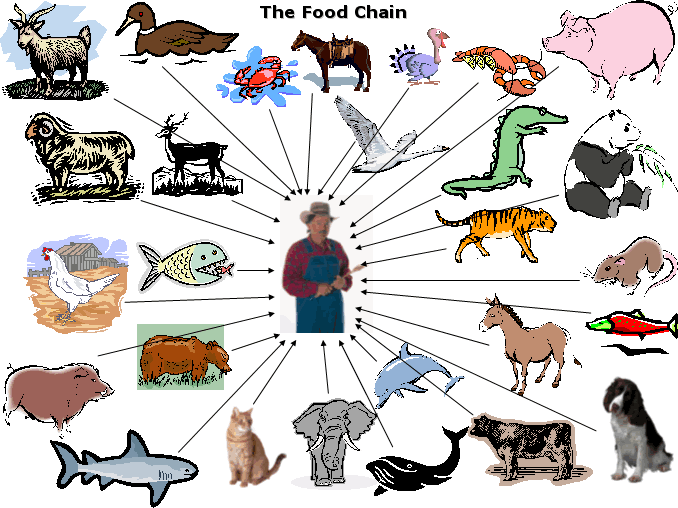
In Genisis 1:20, God says “’Let the earth bring forth living creatures according to their kinds- livestock and creeping things and beasts of the earth according to their kinds…” Then, a few days later, God says “Let us make man in our own image, after our likeness. And let them have dominion over the fish of the sea and over the birds of the heavens and over every creeping thing that creeps on the earth.” This is the definition of man that I believe in. This definition charges man with the task of having dominion over animals. This is where it starts to get a bit tricky though. What does it mean to have dominion over something?
I personally have a hard time with the idea that humans and animals are equal beings. Yes, we both do share in life and death, but it is impossible for me to assign the same value to an animal’s life as I do to a human’s. I believe instead that as humans we should care for animals and nature with a certain degree of compassion and respect, but, for me at least, humans are ultimately more valuable and inherently important. I say this not to demean animals in anyway, but to emphasize that there is difference between man and animal.
According to the course packet, and Richard Dawkins, this/my point of view is a “breath taking speciesism of our Christian inspired attitudes” (199). If speciesism is a description of my belief concerning the state in which humans and animals exist in relation to one another, then I am most definitely a speciesist. However, if the term carries with it the pre-conceived idea that if you are specieist, you have nothing but malice for animals and “lower” forms of life, then I would argue to the bitter end that I am not a specieist.
Anyways, Philip K. Dick, in his novel Do Androids Dream of Electric Sheep? Says:
“’An android, he said, ‘doesn’t care what happens to another android. That’s one of the indications we look for.’”
I couldn’t help but think of the movies WALL-E and The Matrix trilogy. WALL-E is a movie all about how WALL-E, a robot, learns the capacity for affection. I have never met a person who actively criticizes WALL-E as a bad movie. For some reason, it is an extremely endearing movie. Why is it so fascinating when things that are blatantly not-human, such as robots, learn to feel human emotion? We see the s same thing at one point in The Matrix trilogy. At one point, Neo meets a program in the Matrix that is trying to smuggle his daughter out of the Matrix so that she won’t be deleted. Neo asks him why he is doing this. The program replies that he loves his daughter. Neo, in true Keanu Reeves form, is perplexed, so the program tries to explain to him. He says that he doesn’t want his daughter to be destroyed, and that he has a bond or connection with her.

Love and affection are both emotions that undoubtedly separate us from machines but do they separate us from animals too? There are all kinds of movies and books that actively ‘personify’ animals with human characteristics such as the capacity for complex thought and speech, but I have never come across an animal capable of either (at least not comparably to humans). Judging by my own experience, I am forced to conclude that humans and animals are not equal.

No comments:
Post a Comment