Wednesday, February 24, 2010

There's No Such Thing As Free Meal...

Michael Twining

I once tried to write down everything I ate or drank for an entire month in order to get a better idea of my diet, and how unhealthy most of my eating habits were/are. I didn't do this 'exercise' to find out how much manufactured meat I ate, but looking back on it now, it definitely put things in perspective for me. I am constantly eating meat: chicken, beef, pork. It is the way I was brought up, and it is something that I have done for the past 21 years, so "meatism", if you want to call it that, is something that is pretty deeply rooted in my life. My thoughts are opinions on meat-eating are pretty strong, but they aren't what I want to focus on here. Instead, I want to take a quick look at the Humane Slaughter Act and its effect on the food industry.


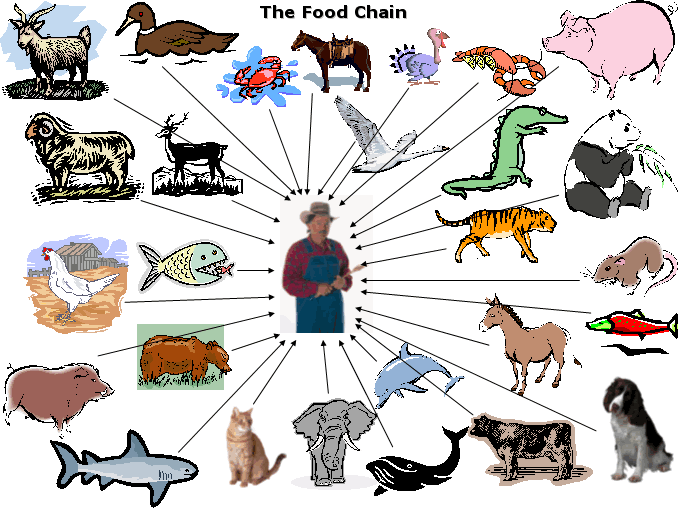
The HMSLA essentially says that an animal must be "stunned" before it can be slaughtered and processed for meat. This act addresses a major ethical question of the food industry: how should we be tr(eating) our food before it ends up on our plates? "The HMSLA is also criticized because despite being the only US law designed to protect livestock, it only focuses on the last few minutes of animal's lives, and has no effect on how they are treated beforehand, even as they are going to slaughter." (690) The HMSLA fails to establish a code or standard for the treatment of animals before they go to the chopping blocks. This is highly disturbing to me. I feel that if you are not opposed to the idea o eating meat (like me), you should at least want the freezer-bound animals to be treated humanely as they mature into fully grown livestock/poultry/fish. The sad part to me isn't that the majority of people WANT their animals to be brutalized in life, it is just that they don't really know about it. This is why movies like "Earthlings" and "Food Inc." are so shocking and disturbing to viewers. "Factory farming's success depends on consumer's nostalgic images of food production- the fisherman reeling in fish, the pig farmer knowing each of his pigs as individuals, the turkey rancher watching beaks break through eggs- because these images correspond to something we respect and trust." (599) The natural public understanding of the food industry is that it is the same homely, friendly, rancher-supplied Meat-Store-from-the-homestead kind of market as it was in the late 19th early 20th century. Companies like Hormel and Tyson have completely abandoned the ethical approach to raising livestock for food, and have focused entirely on minimizing costs and maximizing gains.

In his screenplay Earthlings, Shaun Monson says "Since we all inhabit the earth, all of us are considered earthlings. There is no sexism, no racism or specieism in the term earthling. It encompasses each and every one of us: warm or cold blooded, mammal, vertebrate, invertebrate, bird, reptile, amphibian, fish, and human alike. Humans, therefore, being not the only species on the planet, share this world with million of other liver creatures, as we evolve together". (690) I do no at all believe that humans and animals are equal beings. That being said, however, I think that humans have a great responsibility to care for the earth and for all of it inhabitants. It is our duty as beings of intelligence and compassion to deal with ethical issues in a responsible manner. It is cheaper to be cruel, and it always has been.


THE END.

Monday, February 15, 2010

Animals/Humans/Machines

Animals/Humans/Machines

Animals? Humans? Machines?

In his novel Do Androids Dream of Electric Sheep, Philip K. Dick explores popular definitions of life and humanity. I’ve never actually read it (or watched the movie adaptation Blade Runner), but I was fascinated by the idea that humanity is generally defined in comparison to its surrounding. In our course packet, to be human is defined as being “of or relative to humans, relating to or characteristic of activities, relationships, etc., which are observable in mankind as distinguished from (a) the lower animals, (b) machinery/or the mechanical elements, (c) mere objects of events.” (183). This definition talks about humans in respect to 1) animals, 2) technology, and 3) inanimate objects. I asked a couple of friends to briefly define a human, and they did more or less the same thing. It is clear that there is a natural connection or relationship between humans and our surroundings.

In Genisis 1:20, God says “’Let the earth bring forth living creatures according to their kinds- livestock and creeping things and beasts of the earth according to their kinds…” Then, a few days later, God says “Let us make man in our own image, after our likeness. And let them have dominion over the fish of the sea and over the birds of the heavens and over every creeping thing that creeps on the earth.” This is the definition of man that I believe in. This definition charges man with the task of having dominion over animals. This is where it starts to get a bit tricky though. What does it mean to have dominion over something?

I personally have a hard time with the idea that humans and animals are equal beings. Yes, we both do share in life and death, but it is impossible for me to assign the same value to an animal’s life as I do to a human’s. I believe instead that as humans we should care for animals and nature with a certain degree of compassion and respect, but, for me at least, humans are ultimately more valuable and inherently important. I say this not to demean animals in anyway, but to emphasize that there is difference between man and animal.

According to the course packet, and Richard Dawkins, this/my point of view is a “breath taking speciesism of our Christian inspired attitudes” (199). If speciesism is a description of my belief concerning the state in which humans and animals exist in relation to one another, then I am most definitely a speciesist. However, if the term carries with it the pre-conceived idea that if you are specieist, you have nothing but malice for animals and “lower” forms of life, then I would argue to the bitter end that I am not a specieist.

Anyways, Philip K. Dick, in his novel Do Androids Dream of Electric Sheep? Says:

“’An android, he said, ‘doesn’t care what happens to another android. That’s one of the indications we look for.’”

I couldn’t help but think of the movies WALL-E and The Matrix trilogy. WALL-E is a movie all about how WALL-E, a robot, learns the capacity for affection. I have never met a person who actively criticizes WALL-E as a bad movie. For some reason, it is an extremely endearing movie. Why is it so fascinating when things that are blatantly not-human, such as robots, learn to feel human emotion? We see the s same thing at one point in The Matrix trilogy. At one point, Neo meets a program in the Matrix that is trying to smuggle his daughter out of the Matrix so that she won’t be deleted. Neo asks him why he is doing this. The program replies that he loves his daughter. Neo, in true Keanu Reeves form, is perplexed, so the program tries to explain to him. He says that he doesn’t want his daughter to be destroyed, and that he has a bond or connection with her.

Love and affection are both emotions that undoubtedly separate us from machines but do they separate us from animals too? There are all kinds of movies and books that actively ‘personify’ animals with human characteristics such as the capacity for complex thought and speech, but I have never come across an animal capable of either (at least not comparably to humans). Judging by my own experience, I am forced to conclude that humans and animals are not equal.

Wednesday, February 10, 2010

Fantastic Mr. Me

Michael Twining


For as long as I can remember, I have always been fascinated with animals. I was intrigued with their bodies, the physical differences between humans and animals. I was also spellbound by their behaviors, instincts, and patterns of life (characteristics which I absorbed mainly by watching people like Steve Irwin and Jeff Corwin on Animal Planet). It is hard to explain a fascination, especially to something as un-relatable as a wild animal, but I would constantly find myself outside exploring nature, or trying to catch squirrels or frogs in the creek behind my house. Trapping animals was a favorite pastime of mine because it was a challenge. There is no excitement in cornering a rock, or watching a stream. Animals, on the other hand, are always in flux. They are constantly observing and reacting to the environment around them. They actively engage life in a way that trees, rivers, and rocks do not. Thinking about it now, the reason behind my fascination with wildlife stemmed from that fact that both animals and humans had within them a capacity for life.

Many cultures and peoples throughout history have assigned great value to this fraternal bond. Native Americans, among others, would adopt what they called totems, a way of representing their specific tribes[1]. They believed these totems to be "ancestrally or fraternally related to the clan, being spoken of as a brother or sister"[1]. They believed, in short, that a tribe's or individual's animal totem was an outward reflection and representation of the collective. They also believed, in most cases, that totems would serve as a sort of guardian spirits or protectors, shielding them from evil[1]. I can agree that animals can accurately embody certain characteristics and aspects that we might have as people, but I'm slightly skeptical of the idea that our totem animals also serve as our guides and protectors through life.

If, according to popular definition, an animal totem or spirit guide is a representation or expression of personal traits and behaviors, then my totem is undoubtedly a fox. Many of the characteristics that I exhibit can also be seen in the fox, and many of the natural tendencies of the fox are tendencies that I seem to share. Foxes have been glorified in many different cultures throughout history and are famous for behaving in certain ways. Upon examining the fox's reputation and my own behavioral patterns, I am certain that the fox is spirit animal.

First and foremost, foxes tend to have a reputation of being sly. According to the Merriam-Webster online dictionary, the word sly is defined as an adjective meaning "to be clever in concealing one's aims or ends" or "lightly mischievous"[2]. The words 'cunning', 'crafty', and 'tricky' also come to mind. Foxes frequently appear in the popular myths and legends, notably Aesop's Fables, as masters of trickery. In Aesop's "The Fox and The Crow", Master Reynard, the wily fox, sees a crow settle on a branch to eat a fresh piece of cheese. The fox flatters the crow, complimenting her on the shine of her feathers and the brightness of her eyes. He then assures her that she must have the most beautiful voice in the world, and implores her to sing a song. The crow indulges his request, and as she opens her beak to sing, the cheese falls to the ground where the fox snatches it up and trots off to enjoy it. While a true wild fox cannot possibly exhibit such flattery, they certainly employ craftiness. Foxes are famous for their trickery and seemingly magical elusiveness while being hunted. If being chased by hounds, a fox will cross rivers and double back on their own trails in order to throw their scent in order to confuse the pursuing dogs. No other animals are as famous as the fox for being sly and crafty.

Like the fox, I too tend to exhibit a kind of sly cunning on a regular basis. I have always been a problem solver and I am typically capable of thinking up creative and crafty solutions. I have always been obsessed with word play, like the foxes in the myths. True and wild foxes are physically sly, elusive, and clever, traits I have always valued in my speech and way of thought. I'm not a man of many words, but every word I speak or write carries with it a specific and prescribed meaning in order to convey a certain message. I have always assigned great value to my words, and for as far back as I can remember, I have believed that a witty and clever word can be more effective than a forceful one.

In addition, foxes represent the ability to outsmart beings of strength. In another of Aesop's Fables, entitled "The Ass's Brains", a Fox and a Lion go out hunting together. They decide to send a message to an Ass to meet them at a predetermined place to discuss forming an alliance. When the Ass shows up, the Lion kills it. The Lion then instructs the Fox to watch the booty for a while, and warns him not to touch or eat any of it. The Fox, in his eagerness, eats the brains of the Ass. When the Lion returns and demands the Fox to tell him where the brains had gone, the Fox tells him that the Ass never had brains, or he wouldn't have even been tricked into meeting the Lion. In this fable, the Fox exhibits the same kind of cunning as he does in "The Fox and The Crow", but he does so in another significant manner. Recognizing that he could not have possibly beaten the Lion in a battle of strength, he chose to use his quick wit to defend his actions. While his excuse is not not at all honest, it exhibits the Fox's ability to maneuver with a kind of clever grace in a tricky situation.


Much like the Fox, I constantly find myself in binds that require quick thought and mental maneuverability. Growing up, I found myself under the rule of a slightly oppressive mom. She would ground me for almost everything that I would do. I soon discovered that it was easier for me to not directly fight with my mom, but rather to just bide my time until my parents would leave the house, at which point I would resume life as usual for a few hours. On multiple occasions, I would get caught and confronted as to why I might have been in the living room watching TV with my sister, or any number of tricky incriminating situations like that. I made sure that I always had an excuse ready, and to my amazement, I found that they often worked. For example, my junior year in high school, my mom told me that I was grounded until I got a job, so I went out and found work at a computer consulting company down the road from my house. My boss hired me on as a file clerk, and just told me that I could just come help out whenever I felt like it. My mom told me I had to work 8-10 hours a week. After a few months, I decided that it was a better use of my time to tell my mom that I was going to work, but instead, I would just go to the parking lot in front of the office and study or get some reading done. Every now and then, I would drive down the street to Seven Eleven to buy a soda and some chips. On one occasion, as I was driving down the road while I was supposed to be at work, my mom happened to see and immediately called, demanding why I wasn't in the office. I very coolly replied that the soda-machine in the building was out, and I had been sent to the store to go buy everyone drinks. She accepted this as a reasonable excuse, and I avoided a boat-load of trouble.


One last notable characteristic that I tend to share with the Fox is its ability to avoid conflict, and blend in with its surroundings. Foxes are generally noted for being creatures of transition. They are famous for rarely being seen, and when they are, it is most often at dawn or dusk (not quite the day, and not quite the night). Foxes value camouflage, and fox totems are believed to have the ability to meld into their surroundings, allowing them to quietly observe everything around them. A Fox is clever, but more importantly knows that cunning is useless without knowledge of its surroundings. After all, avoiding a confrontation altogether is always better than managing to weasel your way out of one. This ability to blend in and go unnoticed when I want to is also a strength that I exhibit. I have no problems being clever in times of need, but I too can blend in with my environment and learn to pick my fights (or just avoid them). For example, as a student of Literature, I find myself in many courses filled with extremely opinionated and outspoken classmates. I never make any bold or outrageous claims about books or philosophy if I know that it might offend someone, or cause a huge debate which might put me in the line of fire. I would much rather use my ears to gather as much information about my classmates world-view as possible before I set my tongue to work. That being said, though, I was brought up to take a stand for things that I know to be right and true in my life, so I only practice this strategy of screening my battles when it comes to things that don't have much bearing on my beliefs or convictions. I also find that I rarely take sides in open debates. Oftentimes, I will have strong opinions on things, but I tend to keep those opinions internalized as much as possible.

Socrates famously said, "The unexamined life is not worth living"[3]. In my attempt over the past twenty-one years to examine my existence and make connections with life and nature in this world that I live and move in, I have learned things both about myself and about my surroundings. I have noted how I share behaviors and characteristics with my peers and with everything around me. While I do not believe that I have a protector Fox guiding me and shielding me from harm, I do believe that I can relate specifically to foxes on many levels, and I can learn much about myself and life by studying the fox. Thus, I am convinced that I am akin to the fox in the way that I approach life in many, if not all situations.


Total Word Count: 1,820
without Quotes: 1,794

Bibliography

Bump, Jerome. "Animal Humanities, Volume 1" Jenn’s Copy & Binding, 2010.

Plato. The Apology, Phædo and Crito, trans. by Benjamin Jowett. Vol. II, Part 1. The Harvard Classics. New York: P.F. Collier & Son, 1909–14; Bartleby.com, 2001. www.bartleby.com/2/1/. [Date of Printout].

Merriam-Webster Online Dictionary: http://www.merriam-webster.com/

Media

Illustration 1: Autumn Fox, http://z.about.com/d/healing/1/0/i/D/1/totem-autumnfox.jpg

Illustration 2: The Fox and the Crow, http://www.1st-art-gallery.com/thumbnail/202354/1/The-Fox-And-The-Crow,-Illustration-From-Aesops-Fables,-Published-By-Heinemann,-1912.jpg

Illustration 3: Sleeping Arctic Fox, http://static.guim.co.uk/Guardian/environment/gallery/2008/jul/07/1/GD7965127@Sleeping-Arctic-Fox---3292.jpg

Video 1: http://www.youtube.com/watch?v=XT6XPHXK4e4